
Components
freemkv is a family of eight Rust crates. Two are front ends you run (the freemkv app and command line, and the autorip service); the rest are libraries they share, plus a drive emulator for testing. Each section below says what the piece owns, what it deliberately leaves to someone else, and where to read more.
freemkv
Section titled “freemkv”The desktop app and command line, for Windows, macOS, and Linux. On the command line every operation is a source and a destination as scheme:// stream URLs: rip a disc to MKV, copy a disc to an ISO, remux an existing image, or inspect a disc. The desktop app does the same jobs through a window: pick titles and tracks, choose a format, press Rip.
- Owns: the user interface, command parsing, and output to the terminal or window.
- Does not: implement ripping, recovery, or decryption itself. It drives freemkv-engine and libfreemkv, gets keys from freemkv-keysources, and takes its wording from freemkv-i18n.
See the CLI reference. Get it from the Download page. Source: freemkv/freemkv.
autorip
Section titled “autorip”A headless auto-ripping web service. Insert a disc and it rips to MKV on its own: it detects optical drives, runs the full sweep, patch, and mux pipeline, and serves a web UI for settings, live progress, and history. Runs as a single binary, or via Docker on Linux.
- Owns: drive detection, the rip-on-insert trigger, the web UI and HTTP API, and job history.
- Does not: have its own rip logic. It runs the same freemkv-engine as the desktop app and command line, so both behave identically on the same disc.
See the autorip service. Published to GHCR at ghcr.io/freemkv/autorip:latest. Source: freemkv/autorip.
freemkv-engine
Section titled “freemkv-engine”The shared rip engine: disc-to-MKV orchestration over libfreemkv, used by every front end. Recovery moved here from libfreemkv in 1.6.0.
- Owns: recovery (the sweep and patch passes, the mapfile, and multipass retries), the multi-title rip loop, preflight checks, and resolving keys through freemkv-keysources.
- Does not: talk to the drive or decrypt sectors directly (that is libfreemkv), or present anything to a user (that is the front ends).
See How recovery works. Source: freemkv/freemkv-engine.
freemkv-keysources
Section titled “freemkv-keysources”Key lookup for AACS discs. Pluggable sources (a local keydb.cfg, or an online key service) that look a disc up and hand libfreemkv its unit keys. This is how decryption keys reach the decryption pipeline.
- Owns: reading and downloading
keydb.cfg, and querying the key service. - Does not: derive or apply keys. libfreemkv does all the AACS work once it has them.
Source: freemkv/freemkv-keysources.
freemkv-i18n
Section titled “freemkv-i18n”The locale strings used by the front ends, bundled into the binary with on-disk overrides, and English as the fallback.
- Owns: loading translations and formatting messages, including the text for error codes.
- Does not: appear below the front ends. The libraries never produce English text, so translation happens in one place.
Source: freemkv/freemkv-i18n.
libfreemkv
Section titled “libfreemkv”The core library. Everything that touches the disc lives here.
- Owns: drive access over SCSI; disc scanning (UDF, playlists, titles, and streams); stream labels; AACS and CSS decryption; and demuxing and muxing to MKV, MP4, and M2TS.
- Does not: read
keydb.cfgor download keys (AACS keys come from the caller, usually via freemkv-keysources); run recovery (that is freemkv-engine); or produce English text. Errors are numeric codes, listed in Error codes.
See the library overview. Source: freemkv/libfreemkv.
freemkv-unlock
Section titled “freemkv-unlock”The drive-level unlock layer, the base crate libfreemkv builds on. An unlocker removes a drive-level barrier so the drive serves readable sectors; libfreemkv runs it during drive setup, so front ends never see it.
- Owns: the unlocker contract and the self-contained unlocker modules for supported drives.
- Does not: decrypt content. Unlocking a drive is separate from AACS or CSS decryption (see Unlocked drives).
Source: freemkv/freemkv-unlock.
A drive emulator used as a test fixture. It intercepts Linux SCSI calls and answers from captured drive responses, so the drive, decryption, and recovery paths can be tested without a physical disc. Linux only; not something you install to rip.
- Owns: emulated drive profiles and the SCSI interception.
- Does not: ship to users. It exists for development and CI.
Source: freemkv/bdemu.
How they fit together
Section titled “How they fit together”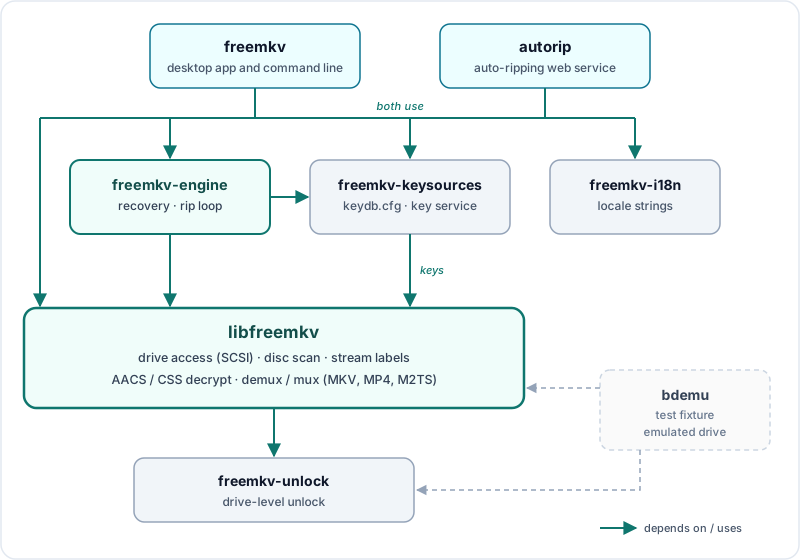
The front ends stay thin: freemkv and autorip handle the interface, freemkv-engine runs the rip, and libfreemkv does the disc work underneath, with freemkv-unlock preparing the drive. Keys enter from the side through freemkv-keysources, and user-facing text is added only at the top through freemkv-i18n. bdemu stands in for a real drive in tests.